Organisational Therapy
In strategy as in therapy, clients usually already have the answer. It might be right in front of them, but they are so used to it that they have stopped noticing.

At times, people outside my professional circles tell me they do not really understand what I do. They might assume that obscurity is intentional, as if I were a spy. French advertising legend Jacques Séguéla mused: "Don't tell my mother that I work in advertising; she believes I play the piano in a brothel".
My parents never understood what I do. When people ask me, I try to offer simple statements, free of jargon and boring details, such as "I help people clarify why they do what they do, how they do it, and why it matters". That's not wrong, but a bit generic. I worked as a designer, and now I am a brand strategist. But the words Design, Brand and Strategy are very broad terms and need qualification.
For brevity, I may use the term brand consultant. But that doesn't sit comfortably with me. It doesn't tell the whole story, and it puts me in company I don't belong to. A large number of agencies and consultants offer to design your brand, devise your strategy and perform a plethora of related activities. But what do they mean in practice? My parents would be none the wiser.
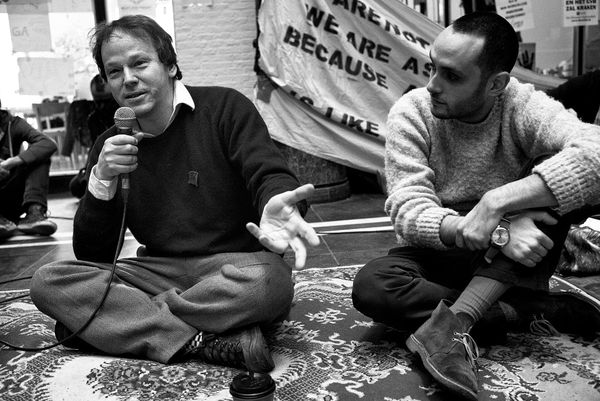
One day my cousin Fabrizio, CEO of a hotel group, asked me to have a chat about brand. After an hour in which I mainly asked him questions, he said: "It seems to me that you act like a therapist, but for organisations." His quip names a truth about the nature of my work. Brand strategy can be compared, in an organisational context, to what psychotherapists do with individual clients. Strategists work with groups of people to help them make sense of their thoughts, feelings, and behaviours to find purpose and alignment.
Why am I reluctant to identify as a brand consultant? Both therapists and consultants get a bad rap because too many practitioners work at the surface. Many adopt a 'paint by numbers' approach to brand strategy development, using formulas and templates (onion, temple, key...) which they fill with words. I have witnessed highly paid executives spend entire meetings arguing about a word. Some agencies try to sell a 'proprietary' method: a list of steps, packaged in some fancy terminology, and trademarked.
One thing I learned in 30+ years of doing this is that there is no formula for strategy and creativity. There are deliverables and common elements, but the work is different every time because people and cultures are different. Brands start and end with people. The first step for any strategy is to talk to the relevant people to formulate a diagnosis of the 'problem' the work needs to solve. In the words of Richard Rumelt: [[1]]
"The kernel of a strategy contains three elements: a diagnosis, a guiding policy, and coherent action"
The job of a strategy consultant is to help people in the client organisation formulate the right diagnosis, develop a guiding policy and orchestrate coherent action. But how does one arrive at the right diagnosis?
A good therapist does not take a client's account at face value, but helps them find the underlying truth. A good strategist looks for the essence of what a client is about, aims to discover their potential and helps them bring it to life. Clients already have the answers, but they may be buried deep. Or it might be right in front of them, but they are so used to it they stopped noticing. The client brief may focus on the symptom and miss some crucial insight. There is always a point in projects where I rewrite the brief based on what I have learned.
That's the diagnosis. Brand strategy is not a communication task, but an act of exploration and co-creation. It requires listening, observation and dialogue. Together, through those, we seek to understand what needs to change and how to change it. The outcome goes beyond deliverables. We uncover the essence and put it at the heart of a generative system. We are not trying to change who they are, or put up a veneer that represents them as something they are not. We aim to get to the core of who the organisation is.
What people see – a logotype, a tagline, a positioning statement, a press release – is the tip of the iceberg. They are symbolic of that deeper truth. The expression may change over time, the essence does not. Many projects start with those public symbols in mind. Clients are understandably keen to get them right as soon as possible. Sometimes the pressure to move fast leads to compressing timelines on the difficult, time-consuming work of deep listening, observing and co-creating. Inevitably, this leads to superficial work, which can be beautiful in the moment, like a new dress, but does not drive substantial, sustainable change that can develop into further possibilities. It is static rather than generative, and ages very quickly.
In 2015, having just left Discovery Europe, my first project as an independent strategist was to lead the Eurosport rebrand. Discovery Inc. had just completed a full buyout, and needed to integrate the two companies while relaunching the brand and its products on a global scale. This was a 26-year-old brand, established and respected, but not loved. Its branding, featuring ten stars, never changed. It read as an institution. TV audiences and sports fans do not seek out institutions.
The Eurosport organisation in Paris was full of journalistic and production talent, but culturally at odds with the London and Washington-based Discovery headquarters. The brief was to relaunch the brand and make it more appealing to audiences. What I heard over months of listening was that appeal was not a branding problem. Both companies were commercially focused, but local teams had come to prioritise advertisers as the primary customers, at a cost to the viewer experience. That's when I rewrote the brief.
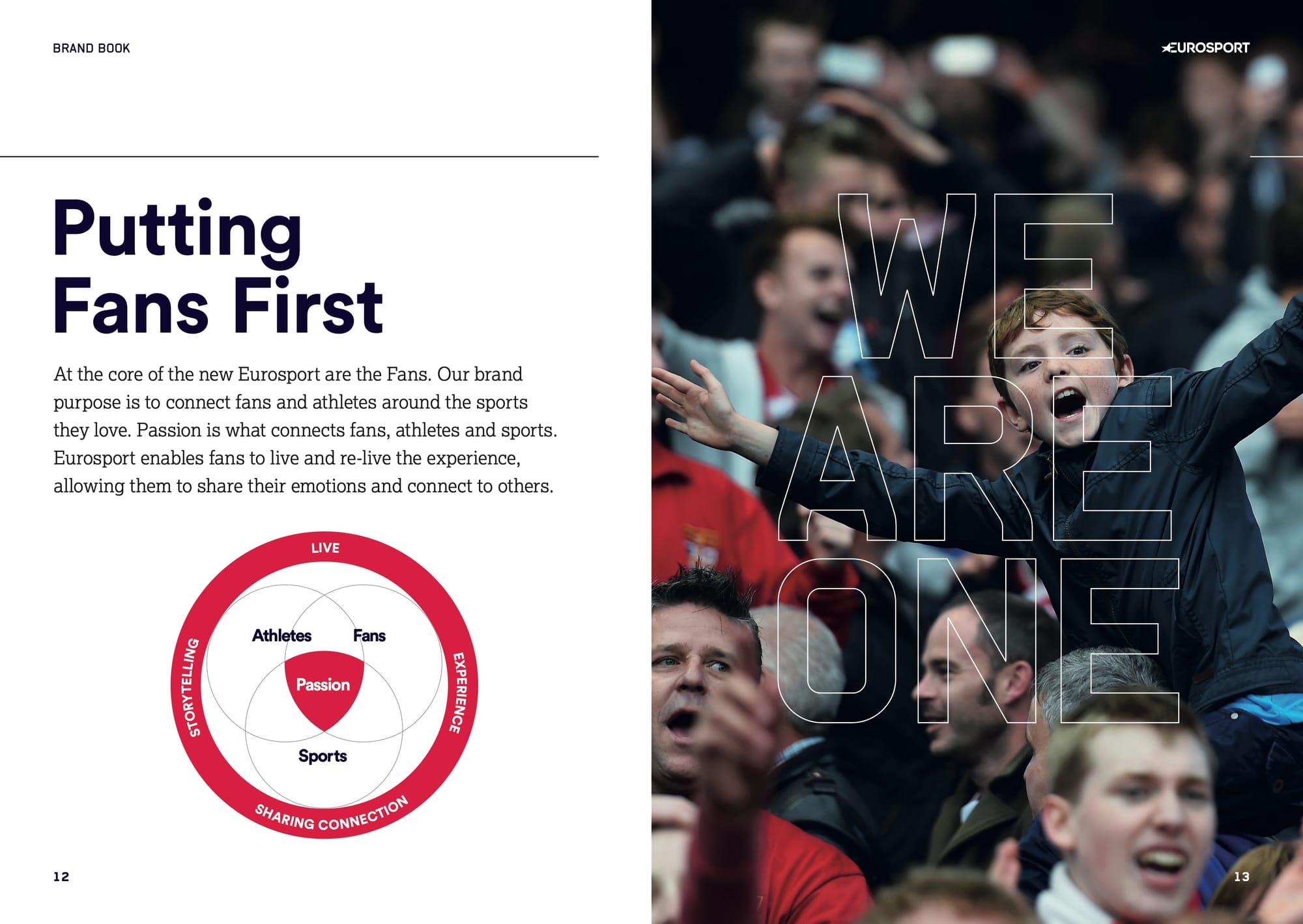
The strategic shift at the core of the new guiding policy was to put fans first. That was not only a marketing choice, but also cultural and operational. Eurosport required much more than a rebrand; it needed a rebirth. The whole organisation needed to work as one for the fans. We summarised it in two words: Team Up. The transformation required teaming up fans with athletes and journalists, different parts of Eurosport and Discovery with each other, and creative agencies with internal teams.
I worked with the CEO and the executive team to coordinate and align the internal teams – Marketing, Programming and Operations – the corresponding international functions at Discovery, and a number of external agencies. As part of the process, I ran a number of competitive pitches, and worked with the executive and marketing teams to select the agencies for the brand work: London-based Pentagram (brand identity) and Dixon Baxi (on-air graphics), and Paris-based Sid Lee (brand narrative).
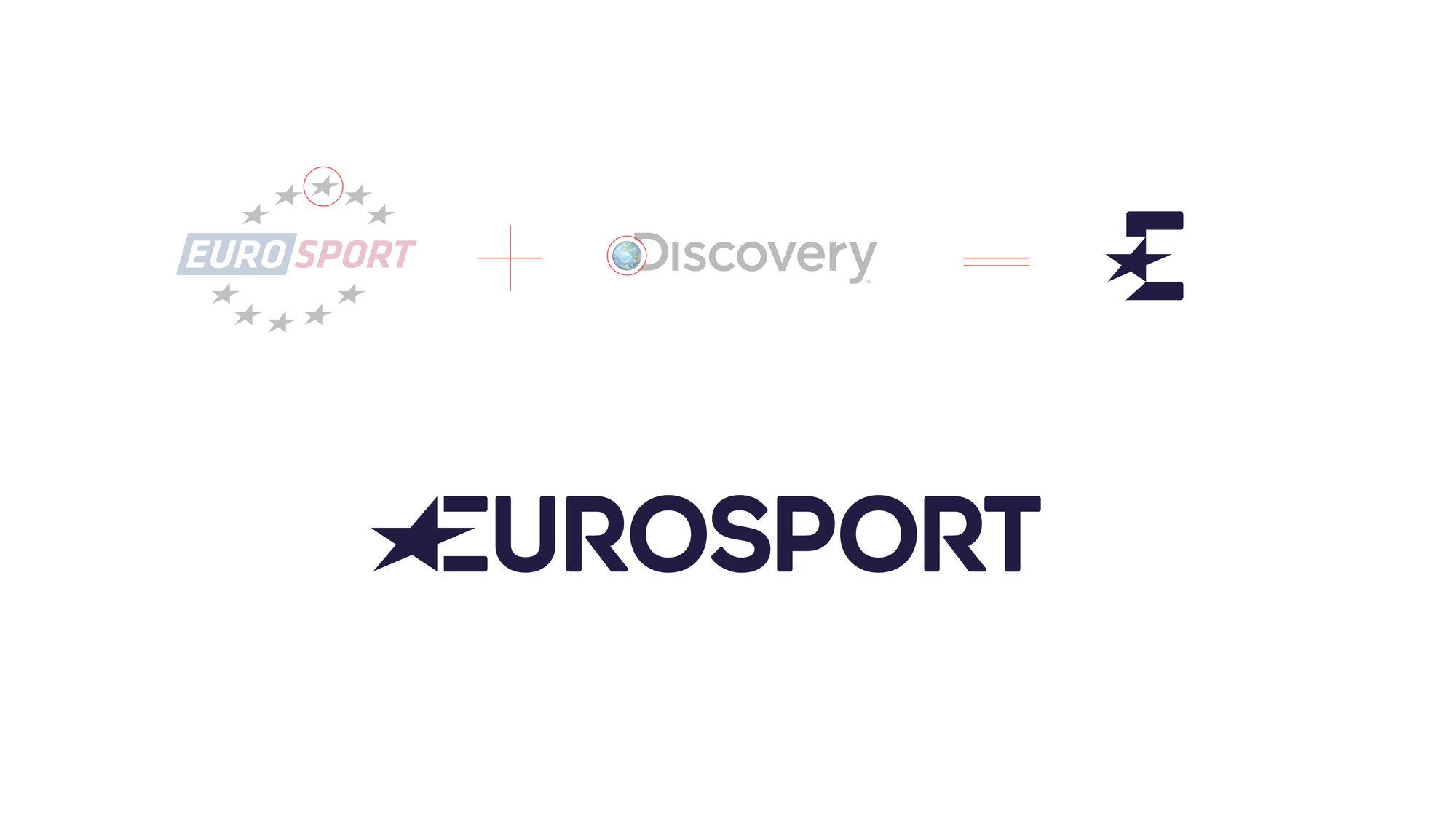
Angus Hyland's team at Pentagram proposed to carry across only one of the stars from the old logo. Ten stars echoed the European flag. One star stood for excellence. Set into the E, it also echoed the globe inside Discovery's D, so the new relationship showed up visually rather than just in a press release. The outcome was not just a logo or a tagline, but a system of symbols designed to facilitate a collective identity project.
The ultimate test of the work is what the system does once we leave the room. In the years that followed, new teams and agencies worked on several campaigns, from the global launch of the reborn brand to multiple Olympic Games. Ten years on, they are still making stand-out work from that core system, and many of them never met the people who created it.
A veneer and an essence may look the same on arrival. The difference does not show up in the presentation. It shows up years later, or it doesn't. It's very difficult to tell them apart until you have been through it. The 'Brand consultant' label only names the parts you can see.
[[1]]: Rumelt, R. (2011). Good Strategy Bad Strategy: The Difference and why it Matters. United Kingdom: Profile Books.